The Sfântu Gheorghe programme of the 9th Graphic Art Biennial of Szeklerland began on 1 October with Distinguishing Marks, a solo exhibition by Italian graphic artist Marco Trentin, Grand Prize winner of the 8th edition of the Biennial. Hosted at the Arcaded House, the exhibition explores questions of identity, recognition and identification, while also reflecting on the relationship between the individual and external systems of power.
The title of the exhibition draws its conceptual basis from the practices of personal identification and recognition. It refers to the distinctive features by which a person can be identified and which may be recorded in official registers and identity documents. Taking these administrative and bureaucratic categories as his starting point, Trentin examines the paradox inherent in the attempt to record and describe identity.
In his works, the complex and ever-changing nature of the individual is confronted with the reductive logic of identification, which reduces personality to a limited set of distinctive, cataloguable characteristics. Through this tension, the artist asks how individual features become evidence of identity and how the need for recognition and identification transforms our perception of a person.
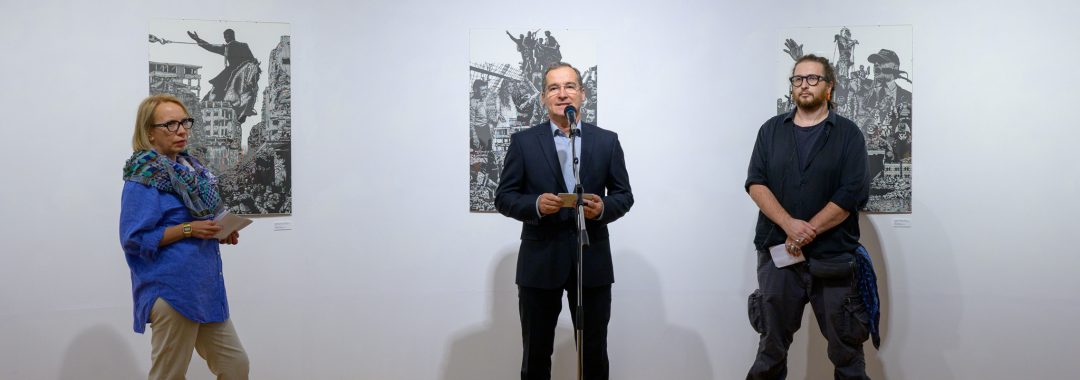
The opening was hosted by Mihály Vargha, sculptor and director of the Szekler National Museum, who welcomed Marco Trentin and the audience. In his remarks, he drew attention to the striking relevance of the exhibition. In his view, the questions raised by the works resonate directly with contemporary reality and acquire particular force when considered in the context of events unfolding in today’s world.
Mihály Vargha also reflected on the development of the Graphic Art Biennial of Szeklerland over the years. He noted that the event’s reputation and professional standing have continued to grow from one edition to the next, a development reflected not only in increasing international interest in the Biennial but also in the evolution of its artistic and organisational processes.
The exhibition was opened by Dr Iréne Kányádi, art historian, who interpreted the works in the context of the systems of surveillance, administration and social control that increasingly shape contemporary identity. She pointed out that one of the central questions in Trentin’s work is what it means to be catalogued in an age of algorithmic tracking, digital footprints and constant surveillance, how personal identity can be preserved, and what possibilities remain for individual resistance.
One of the exhibition’s recurring motifs is the human body, which appears in Trentin’s works both as a bearer of identity and as a surface that can be measured, classified and recorded by external systems. Scars, birthmarks, height and other distinguishing features thus move beyond the everyday practice of identification. In these works, such signs become part of the relationship between the individual and power, between personal freedom and institutionalised control.
Iréne Kányádi also drew attention to war and violence as recurring themes in Trentin’s work. His woodcuts depict weapons, tanks, soldiers, ruined buildings and figures of authority, creating a visual world shaped by conflict. Alongside these expressive and at times chaotic compositions, personal portraits also appear, contrasting individual sensitivity and complexity with the impersonality of war and administrative systems.
At the same time, the body also contains the possibility of resistance in the artist’s thinking. As Trentin puts it, “we are the bulwark against the complex mechanisms that we ourselves construct”, while the body and our own perception of reality enable us to create personal realities.
The conceptual complexity of the exhibition is further reinforced by Trentin’s choice of techniques. By placing traditional woodcut alongside digital inkjet printing, he brings two distinct visual worlds into dialogue. The raw, physical and immediate character of the hand-carved woodblock carries the trace of the artist’s personal presence, while the precision of the digital print evokes the more impersonal world of technological systems. The encounter between the two media thus becomes part of the tension between human, organic existence and the ordering logic of technology.
In Iréne Kányádi’s interpretation, Distinguishing Marks is not only an exhibition about identity, but also a critique of the modern human condition. The possibility of resistance is particularly present in the portrait series Private Identity: while external systems may record and quantify certain human characteristics, the full complexity of personal identity can never be entirely contained within categories.
According to the art historian, Trentin’s works do not allow the viewer to remain a passive observer. Instead, they encourage us to question our own position: how much of ourselves we surrender to the systems operating around us, what we are able to preserve of our personal identity, and how we choose to respond to social injustice.
At the end of the opening, Marco Trentin also addressed the audience. The Italian graphic artist expressed his gratitude for the opportunity to return to the Graphic Art Biennial of Szeklerland with a solo exhibition as the Grand Prize winner of the previous edition. He also spoke briefly about the exhibition and the ideas underlying the works on display.
Distinguishing Marks will remain on view at the Arcaded House in Sfântu Gheorghe until 29 October.
The programme of the 9th Graphic Art Biennial of Szeklerland continues in Sfântu Gheorghe on 2 October. At 6 p.m., the Biennial’s main Sfântu Gheorghe exhibition will open at the Transylvanian Art Centre, where the G9 Award Ceremony will also take place.