
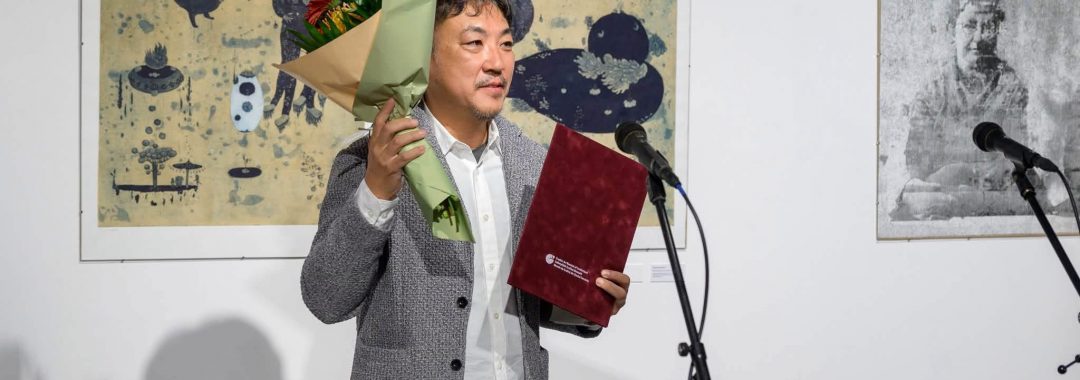
Japanese visual artist Akimitsu Tamawake has won the Grand Prize of the 9th Graphic Art Biennial of Szeklerland. The G9 exhibition in Sfântu Gheorghe opened on 2 October at the Transylvanian Art Centre, where the biennial’s awards were also presented. This year’s open call attracted unprecedented international interest: 1,034 artists from 71 countries submitted a total of 2,195 works.
The opening in Sfântu Gheorghe also served as the awards ceremony of the 9th Graphic Art Biennial of Szeklerland. Alongside representatives of the arts and cultural sector, the event was attended by the heads of the organizing and partner institutions, representatives of the universities and organizations offering the awards, as well as several of this year’s prize-winning artists.
The guests were welcomed by Beáta Bordás, director of the Transylvanian Art Centre. The biennial was organized through the cooperation of Covasna, Harghita and Mureș counties, with several cultural and art institutions from Szeklerland contributing as professional partners.
On behalf of the host county, the audience was welcomed by Sándor Tamás, President of Covasna County Council. In his speech, he reflected on the flood of images that defines contemporary visual culture. While machines and algorithms generate and discard enormous quantities of images every second, graphic art continues to demand time, attention, experimentation and conscious artistic decisions.
“We have gathered here tonight to honour people who dared to stop amid this flood and who did not simply produce images, but created them,” he said.
In this context, Sándor Tamás described graphic art not merely as a technique, but as a form of resistance to the rapidly consumed stream of images surrounding us. He also recalled one of the biennial’s original objectives: to create, through the cooperation of Covasna, Harghita and Mureș counties, an event capable of connecting Szeklerland to the international circulation of contemporary visual culture.
“Tonight, Szeklerland is on the international map of contemporary graphic art. We did not put it there ourselves – more than a thousand artists from 71 countries have printed it onto that map,” said Sándor Tamás.
Hunor Kelemen, President of the Democratic Alliance of Hungarians in Romania, recalled being present at the launch of the Graphic Art Biennial of Szeklerland in 2010 and expressed his pleasure that, sixteen years later, the initiative remains alive, continues to evolve and inspires the creation of new works.
“Through the biennial, Covasna, Harghita and Mureș counties work together in an exemplary way to support artistic freedom, something I consider extremely important. Artists should be free to create and should have the courage to show us how they see the world. Our task is to support them in every way we can,” said Hunor Kelemen, thanking the artists for their intellectual courage and the organisers for their perseverance.
Representing the Consulate General of Hungary in Miercurea Ciuc, Foreign Economic Attaché Fanni Csuzy addressed the audience and spoke about the long-standing cooperation between the Consulate General and the biennial, emphasising the bridge-building role shared by art and diplomacy. While diplomacy creates connections between nations, communities and individuals, she noted, art is capable of doing the same on a deeper level, often without words. She highlighted that the Graphic Art Biennial of Szeklerland has developed into an international meeting point where artists from different countries and cultural backgrounds can connect with one another.
From the Cooperation of Three Counties to an International Biennial
From the outset, the Graphic Art Biennial of Szeklerland has been built on cooperation between the three counties of Szeklerland. Visual artist Zsolt Siklódi from Mureș County, together with the leaders of cultural institutions in Harghita and Covasna counties, played a decisive role in establishing the event. Over its nine editions, the initiative has developed into a contemporary graphic art event with an increasingly extensive international network.
Barna Botond Bíró, President of Harghita County Council, highlighted the importance of cooperation and collective action among the three counties of Szeklerland. He stressed that despite increasingly limited financial resources, Covasna, Harghita and Mureș counties continue to consider support for culture, and contemporary visual art in particular, a priority.
“Despite our local and regional differences, our strength lies in standing together. When we work together and plan our future jointly, our achievements can earn recognition and respect at international level as well,” he said.
Ferenc Péter, President of Mureș County Council, was unable to attend the event in person due to other commitments. His message was delivered by art historian Erika Oniga, museologist at the Art Department of the Mureș County Museum.
Taking this year’s biennial theme, DISTORTION, as his starting point, Ferenc Péter reflected on art’s ability to reshape the way we see the world. A work of art, he noted, can often reveal something new precisely by shifting, magnifying or rearranging what we thought was familiar. Through such transformations, emotions, tensions and questions that were always present in the familiar image can become visible for the first time.
“This is one of the great gifts of art. It can give new form to our experiences and help us understand something about the world, about one another or about ourselves that we had previously been unable to put into words,” Ferenc Péter wrote in his message.
Distortion as an Opportunity to Reinterpret Reality
The professional concept of the 9th Székely Land Graphic Art Biennial was presented by visual artist and biennial curator Apor S. Ferenc. This year’s central theme, DISTORTION, opened up a wide range of interpretations, from physical deformation and psychological shifts to distortions of values and metaphorical transformations.
He emphasised that “in contemporary graphic art, distortion is not merely a formal or geometric deformation. It is a complex means of expression through which artists can reflect on social experiences, questions of identity and memory, transformations of the body and nature, and the uncertainties of our time.”
In this sense, the curator explained, distortion is not an end state but a process – an opportunity to reinterpret perception, thought and our relationship with reality.
Art historian Eszter Túros reflected on the works submitted and selected for exhibition in the ninth edition. She noted that over the years, the Graphic Art Biennial of Szeklerland has become an internationally recognized professional event, offering a broad overview of changing trends in contemporary graphic art.
She pointed out that this year’s theme of DISTORTION connects an exceptionally diverse range of works, both technically and conceptually, while leaving ample room for individual interpretation. The exhibited works explore subjects ranging from identity and the human body to the social and natural environment, as well as more abstract and self-reflective questions. At the same time, they demonstrate the diversity of traditional, digital and experimental graphic techniques.
Akimitsu Tamawake Wins the G9 Grand Prize
Following the opening, the awards of the 9th Graphic Art Biennial of Szeklerland were presented. The Grand Prize, worth €3,000, offered by Covasna County Council and the School of Arts and Crafts in Sfântu Gheorghe, was awarded to Japanese artist Akimitsu Tamawake for his work Seed.
Tamawake received the award in person and thanked everyone involved in organising the biennial. He also recalled the moment he learned that he had won: he was on a flight in July when he received the news. It came as such a surprise that he jumped up with joy and, as he recalled, quietly began to cry.
The Japanese artist also spoke about his creative approach. His work draws strongly on his interest in ancient cultures and history, Japanese picture scrolls, Buddhist art, and Chinese and Korean artistic traditions. Storytelling, he explained, is particularly important to him: he believes a work can hold the viewer’s attention over time when it allows them to imagine both a past and a future.
Ten Awards, One International Community of Artists
In addition to the Grand Prize, nine other professional awards were presented:
- The Nagy Imre Award, offered by Harghita County Council, went to Hungarian artist Péter Jónás for his woodcut Szigetvár.
- The Plugor Sándor Award, offered by Covasna County Council, was awarded to Canadian artist Françoise Legris for her lithograph series Carlos, Héléne, Michael.
- The Nagy Pál Award, offered by Mureș County Council, went to Polish artist Szymon Prandzioch for The Cloud of Unknowing and Plan Your Rest.
- The Lăzarea Artists’ Colony Award was presented to Romanian artist Diana Drăgan-Chirilă for Topografii liminale 2.
- The Visual Arts Award of Eszterházy Károly University went to Polish artist Henryk Krolikowski for Us.
- The Partium Award was presented to Romanian graphic artist Réka Nagy for Csapda II.
- The Award of the Hungarian University of Fine Arts went to Polish artist Malgorzata Jozefowicz for Don’t Forget Us.
- The Award of the MAMŰ Society Cultural Association was presented to Hungarian visual artist Laura Laviv for Persecution.
- The Pulzus Art Colony Award went to Hungarian artist Flóra Toldi for Torzul I–II–III.
The awards ceremony was made particularly memorable by the fact that almost all of the prize-winning artists were present in Sfântu Gheorghe. The event therefore became not only a celebration of the artworks themselves, but also a meeting place for the artists behind them, bringing together creators from different countries and cultural backgrounds.
The Sfântu Gheorghe exhibition of the 9th Graphic Art Biennial of Szeklerland will remain open to visitors at the Transylvanian Art Centre until the end of November.