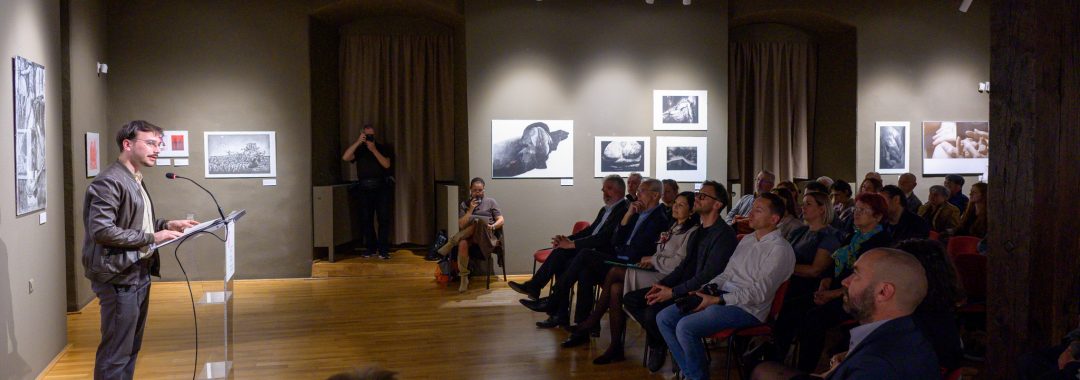
The programme of the Graphic Art Biennial of Szeklerland continued in Miercurea Ciuc on 30 September with the opening of two exhibitions. At the Szekler Museum of Ciuc, the first event was the opening of One and Multiple, an exhibition by the Graphic Art Department of the University of Art and Design in Cluj Napoca, followed by the the official Miercurea Ciuc opening of the biennial. This G9 exhibition brought together works by 126 artists from 28 countries.
One and Multiple: a century of artistic heritage, graphics across generations
The first event of the afternoon was the opening of One and Multiple, an exhibition by the Graphics Department of the University of Art and Design in Cluj-Napoca. Held during the institution’s centenary year, the exhibition looks back at the traditions of graphic arts education while also highlighting the continuous renewal of the medium.
The exhibition brought together works by former and current graphics professors and students, as well as artists who studied in Cluj-Napoca. The works on display encompass a wide range of graphic techniques, from etching and lithography to woodcut, screen printing and linocut.
The exhibition also reflects on the archive of the university’s Graphics Department, which has been developed since the 1960s. Its significant collection of prints, drawings, posters and photographs not only documents the history of an institution, but also traces the ways in which graphic thinking and image-making have evolved over the past decades.
The exhibition was opened by Ferencz S. Apor, curator of the 9th Graphic Art Biennial of Szeklerland, and Dr Cristian Opriș, graphic artist and associate professor.
Artists from 28 countries featured in the Miercurea Ciuc exhibition
Following the opening of One and Multiple, the official Miercurea Ciuc opening of the 9th Graphic Art Biennial of Szeklerland also took place at the Szekler Museum of Ciuc.
The central theme of G9 is DISTORTION, a concept that offers a wide range of interpretations, from physical deformation and psychological shifts to distortions of values and metaphorical deviations. Rather than prescribing a single visual direction, the biennial’s open call created a space for reflection in which artists could explore different forms of distortion through their own experiences and visual languages.
The open call attracted unprecedented interest: during the eight-week submission period, 1,034 artists from 71 countries submitted a total of 2,195 works. Following the selection by the professional jury, the Miercurea Ciuc exhibition brought together works by 126 artists from 28 countries.
At the opening, Enikő Sógor, Deputy Mayor of Miercurea Ciuc, spoke about art’s capacity to create dialogue. As she noted, this dialogue takes place simultaneously between artists from different parts of the world and local artists, between different artistic approaches, between the cultural communities of Miercurea Ciuc and Sfântu Gheorghe, and between the artworks and their viewers. She emphasised that genuine dialogue becomes productive when another person’s thoughts continue to resonate within us, generating new ideas or even inspiring action.
Prof. Dr István Erőss, Rector of the Hungarian University of Fine Arts, placed the biennial’s development and international role within a broader context. Recalling the beginnings of the event, he pointed out that over the course of its nine editions, an international network of artistic connections has developed around the Graphic Art Biennial of Szeklerland, within which the event has now found its own place. In his words, a global field of artistic forces has emerged, one in which the biennial has become an active participant and has established itself among international graphic art events.
In his speech, he also emphasised that culture is one of the most important values Szeklerland can present to the world. In this context, he drew attention not only to the biennial’s current professional achievements, but also to its potential long-term impact: what kind of mark the event might leave on the region’s cultural life ten or twenty years from now, and how it might influence the young people encountering the contemporary art presented here today.
The exhibition’s artistic concept was presented by Ferencz S. Apor, curator of the biennial. He emphasised that distortion in contemporary graphic art is not merely a formal deformation, but a complex means of expression. The deliberate transformation of reality can open up new perspectives while encouraging viewers to reconsider familiar frameworks of interpretation.
As he explained, the works on display are not necessarily images of a distorted world. Rather, they explore how the world becomes an image, and how that image changes from the moment we perceive and interpret it to the moment we give it form and pass it on.
“A distorted image does not necessarily distance us from reality. In some cases, it can actually bring us closer to it. It can reveal something that regular, familiar forms conceal,” Ferencz S. Apor emphasised.
Tamás Lénárt, art historian, approached the theme from an art-historical perspective. He pointed out that distortion has played different roles throughout different periods: from the spiritual significance of prehistoric representations and the visual hierarchy of ancient Egypt, through the deliberate manipulation of form in Mannerism, to interpretations of reality in modern and contemporary art.
He also highlighted the distinctive nature of graphic art, which makes the medium particularly well suited to expressing the idea of distortion. By their very nature, graphic processes shape, mediate and rearrange the reality they represent. Cutting, etching, printing, layering and rhythm are all part of the process through which an original image is transformed into a new visual form.
The works on display presented numerous interpretations of distortion. Some explored the human body, identity and the layered nature of personality, while others reflected on the transformation of nature and the built environment or addressed social and ecological issues. Some abstract works broke down the recognisable elements of reality to the point where the reference itself became uncertain.
Tamás Lénárt also addressed art’s capacity to offer a means of action. “Imagination is the final stronghold over which the artist retains eternal power. In the face of existential anxiety about the future, the greatest act of rebellion and the most effective form of activism is creation,” he said.
The Miercurea Ciuc exhibition of the 9th Graphic Art Biennial of Szeklerland showcased both the technical diversity of contemporary graphic art and the remarkably broad conceptual field in which the medium operates today. Alongside traditional relief, intaglio and planographic printing techniques, the exhibition included digital prints, mixed-media works combining photography and collage, as well as experimental approaches to graphic art.
Within this context, DISTORTION emerged not as a final state, but as a process: an opportunity to continuously rearrange the ways in which we see, think and relate to reality. Rather than offering a single answer, the works approached the same set of questions from different cultural, social and personal perspectives.
The Miercurea Ciuc exhibition is open to visitors until 29 November at the Szekler Museum of Ciuc.
The programme of the 9th Graphic Art Biennial of Szeklerland continues in Sfântu Gheorghe on 1 October. At 6 p.m., Italian artist Marco Trentin, Grand Prize winner of the 8th Graphic Art Biennial of Szeklerland, will present his solo exhibition Distinguishing Marks at the Arcaded House. On Friday, 2 October, at 6 p.m., the Transylvanian Art Centre will host the opening of the biennial’s Sfântu Gheorghe exhibition and the G9 award ceremony.
The event series is jointly organized by Covasna, Harghita and Mureș counties, the School of Arts and Crafts in Sfântu Gheorghe, the Szekler Museum of Ciuc, the Lăzarea Cultural and Art Centre, the Transylvanian Art Centre and the Mureș County Museum.